Lok Sewa Aayog (Public Service Commission) was established in 1st Asar, 2008 B.S. (corresponding to 15th June 1951 A.D.) with the aim of recruiting civil servants independently and impartially, following the establishment of democracy in the country in 2007 B.S. Since its inception, the commission has been performing the task of selecting suitable candidates for positions in the civil service.
According to the Constitution of Nepal, the Public Service Commission conducts written examinations for filling vacancies in the civil service, Nepalese Army, Nepal Police, Armed Police Force, Nepal, and other federal government services. Provisions related to the PSC have been made in Part 23 of the Constitution of Nepal.
Formation
According to the provision on the formation of the Public Service Commission in subsection (1) of Section 242 of Part 23 of the Constitution of Nepal, the commission will consist of a Chairman and four other members. The President appoints the Chairman and members of the Public Service Commission on the recommendation of the Constitutional Council, and when such appointments are made, at least fifty percent of the members of the Commission must be individuals who have served in government service for twenty years or more, and the remaining members are appointed from individuals who have earned fame in science, technology, art, literature, law, public administration, sociology or other fields of national life through research, study, teaching, or other significant work.
Before such appointment, there is a provision for a parliamentary hearing through a 15-member joint committee consisting of members of both houses of the Federal Parliament as per federal law. The constitution stipulates that only five officials, including the Chairman, will serve in the commission. Before the implementation of this constitution, more officers than this were working in the commission. Therefore, the constitution has given continuity to the appointment of the former seven officers as per subsection (3) of Section 301 of the Constitution of Nepal.
Functions, Duties, and Rights
As per Section 243 of the Constitution of Nepal, the Public Service Commission’s responsibility is to conduct examinations to select suitable candidates for appointment to civil service posts. The term “civil service posts” clearly excludes posts in the Military or Nepal Police or Armed Police Force, posts in employees’ service of Nepal, and posts other than civil service as specified by law.
Similarly, the Public Service Commission is also responsible for conducting written examinations for filling posts in the Nepalese Army, Nepal Police, Armed Police Force, Nepal, other federal government services, and organized institutions, other than civil service posts.
In addition to the above duties and responsibilities, there is a provision to consult the Lok Sewa Aayog on the following subjects:
- General principles to be adopted when promoting posts in the Nepalese Army, Nepal Police, Armed Police Force, Nepal, and other federal government services;
- Matters of general principles to be adopted when promoting and departmentally proceeding the employees’ service of any organized institutions;
- Matters of civil service-related laws in federal civil service;
- Matters of principles to be adopted when appointing, promoting, and departmentally proceeding in federal civil service or posts;
- Matters of the suitability of the candidate when appointing in the civil service post for more than six months;
- Matters of suitability of the candidate when initiating or promoting from one type of federal civil service post to another type, or from other government service to federal civil service, or from a provincial civil service post to a federal civil service post or from a federal civil service post to a provincial civil service post during service change or transfer;
- Matters when permanently initiating or promoting an employee in a post where the consultation of the Public Service Commission is not required to a post where the consultation of the Public Service Commission is required;
- Matters of departmental punishment are to be given to federal civil service employees.
Candidate Selection Process
As per the Public Service Commission Act, 2066, the commission will select suitable candidates through one or more of the following methods:
a) Written examination,
b) Practical examination,
c) Interview, and
d) Other methods specified by the Commission.
The Commission prepares an annual work schedule for the candidate selection process, which includes details of the selection processes at various stages, starting from the determination of the percentage of vacant posts.
Upon receiving a request from the concerned body to fill the vacant posts, the Public Service Commission determines the number of positions to be filled in accordance with the relevant laws and regulations. After determining the number of positions, the Commission publishes advertisements in the bulletin that is published weekly on its website every Wednesday, and in the Gorkhapatra National Daily. While publishing the advertisement, At the time of advertisement, applications are invited with a deadline of 21 days and additional 7 days for conducting the open internal competitive examination
After the publication of the advertisement for open and internal competitive examinations, the Commission collects online applications for the advertised positions from the Regional Direction Offices, Zonal Offices, and Application Management Centers. The applications received for the advertised positions are scrutinized, and admission cards are issued to candidates eligible to participate in the examination.
In order to maintain impartiality and integrity in the selection process, the Commission has adopted a policy of maintaining confidentiality, in which officers involved in the written examination and interview are not aware of each other’s work. This includes procedures such as question paper preparation, question paper editing, answer sheet examination, interview conduct, and so forth.
In the process of performing the said tasks, experts in the relevant subjects are sent to create the question papers necessary for conducting examinations for the related service groups and positions. The set of such raw question papers is received confidentially, from which a minimum of 5 sets of question papers are prepared by another expert in the same subject, each set is separately marked with a reference number and the set of question papers chosen based on the reference number by the honorable chairman of the commission is used during the conduct of the examination. After conducting the written examination, all the answer sheets received are first coded by the Examination Conducting Branch, and another code is given by an officer of another branch to maintain the highest secrecy in the examination. After the second coding, the received answer sheets are sent to the relevant subject experts/ specialists selected by the Honorable Chairman for examination. After the examination, the scores obtained in the answer sheets are tabulated, decoded based on the code, and the results are published. The candidates selected for the interview are interviewed with the involvement of the relevant subject experts as well, the score given by one is kept confidential and is only opened during the time of ranking and recommending. Likewise, the score obtained by the candidate in the written examination is only sent at the time of ranking and recommending without being known during the interview.
The Public Service Commission for the work of the commission such as paper setting, paper moderation, answer sheet examination, interview, psychological personality test, curriculum development, etc., the relevant branch includes a list of experts in the relevant subjects as required and regularly updates the list of experts and specialists. The commission assigns them confidentially for any special kind of selection work. The commission has started the process of the Screening Test for certain positions, where more candidates are involved. Only those who pass the preliminary examination will be allowed to participate in the main examination.
After the final selection of candidates from the open competition, the provision is to recommend the concerned body for appointment in the case of gazetted posts and the concerned office in the case of non-gazetted posts. When sending a recommendation letter to the relevant body for an appointment, it is necessary to send a copy of the candidate’s application form and copies of the certificates presented along with it.
From the determination of the percentage to the conduct of the written examination for the security bodies and other government services/organized institutions, the tasks mentioned above are carried out according to the mentioned procedures.
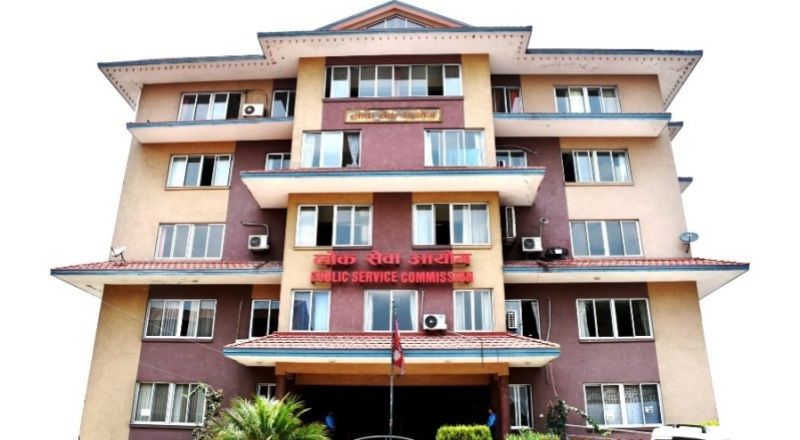
Address:
Public Service Commission,
Central Office,
Kamalpokhari, Kathmandu, Nepal
Phone No: 01-4771494, 01-4771498
Fax: 977-1-4771490
Post Box: 8979
E-mail: info@psc.gov.np
Website: http://www.psc.gov.np
Application Management Office, Anamnagar,
Phone: 01-4770234
| PSC Branch Office Location | Telephone No. | Fax | |
| Lok Sewa Aayog, Dhankuta Office | 026-520130 | eastern@psc.gov.np | 026–520151 |
| Lok Sewa Aayog,Jaleshwar Office | 044-520147 | janakpur@psc.gov.np | – |
| Lok Sewa Aayog, Kathmandu Office | 01-4410859 | machheni@psc.gov.np | 01-4115835 |
| Lok Sewa Aayog, Pokhara Office | 061-463506 | western@psc.gov.np | 061-463506 |
| Lok Sewa Aayog, Butwal Office | 071-540207 | lumbini@psc.gov.np | 071-547807 |
| Lok Sewa Aayog,Surkhet Office | 083-520106 | midwestern@psc.gov.np | 083-521803 |
| Lok Sewa Aayog, Dipayal Office | 094-440147 | farwestern@psc.gov.np | 094-440178 |
| Lok Sewa Aayog, Ilam Office | 027-520062 | – | – |
| Lok Sewa Aayog, Khotang Office | 036-420177 | – | – |
| Lok Sewa Aayog, Hetauda Office | 057-520302 | narayani@psc.gov.np | 057-526822 |
| Lok Sewa Aayog, Baglung Office | 068-520147 | dhawalagiri@psc.gov.np | 068-520147 |
| Lok Sewa Aayog, Dang Office | 082-520013 | rapti@psc.gov.np | 082-520013 |
| Lok Sewa Aayog,Jumla Office | 087-520008 | karnali@psc.gov.np | 087-520008 |
| Lok Sewa Aayog, Mahendranagar | 099-521209 | mahakali@psc.gov.np | 099-523992 |